How to File Taxes with the IRS in 2026: Forms, Software & Costs Explained
Learn how to file taxes with the IRS in 2026—which forms you need, top tax software for tax preparers, small business deadlines, and 2025 CPA fee benchmarks.

Every year, millions of taxpayers stare down the same question: what's the fastest, cheapest, and most accurate way to file taxes with the IRS in 2026? Whether you're a W-2 employee, a freelancer juggling 1099s, or a small business owner managing payroll, the filing process has more moving parts than ever—new e-file thresholds, updated forms, and a growing menu of software options. This guide breaks down exactly how to file taxes with the IRS this year, which forms you actually need, what tax preparers are charging in 2025 filings, and how to keep your small business organized without the last-minute scramble.
How to File Taxes with the IRS: Your Options for 2026
The IRS now offers more legitimate no-cost filing paths than at any point in the last decade, but which one fits you depends on your income type and comfort level with self-preparation.
IRS Free File remains available for taxpayers under the adjusted gross income threshold (indexed annually, typically around $84,000 for the 2025 tax year), giving you access to guided commercial software at zero cost. IRS Direct File has expanded to more states and now supports a wider range of income situations, including some self-employment income—though it still isn't built for complex Schedule C filers with significant deductions. For everyone else, commercial e-file providers (TurboTax, H&R Block, TaxAct, FreeTaxUSA) fill the gap, with pricing that scales based on form complexity.
Paper Filing vs. E-Filing
If speed matters—and for most people, it does—e-filing isn't optional. The IRS processes e-filed returns with direct deposit refunds in about 21 days. Paper returns routinely take 6 to 8 weeks, sometimes longer during peak season backlogs. Unless you have a specific reason to mail a return (certain amended filings or unsupported forms), e-file every time.
When You Must File vs. When You Should File
Filing thresholds depend on filing status, age, and income type—but there's a critical nuance many people miss: self-employment income triggers a filing requirement at just $400 net earnings, regardless of your total income level. Dependents with earned income above the standard deduction threshold, and anyone who had tax withheld they want refunded, should also file even when not strictly required.
Set Up Your IRS Online Account
Before you file, create or verify your IRS Online Account. It gives you access to prior-year transcripts, estimated payment history, and identity verification tools that speed up processing if the IRS flags your return for review. It's also the fastest way to confirm your identity if you're using Direct File or need to respond to an IRS notice later in the year.
Which Form Is Used for US Individual Income Tax Filing?
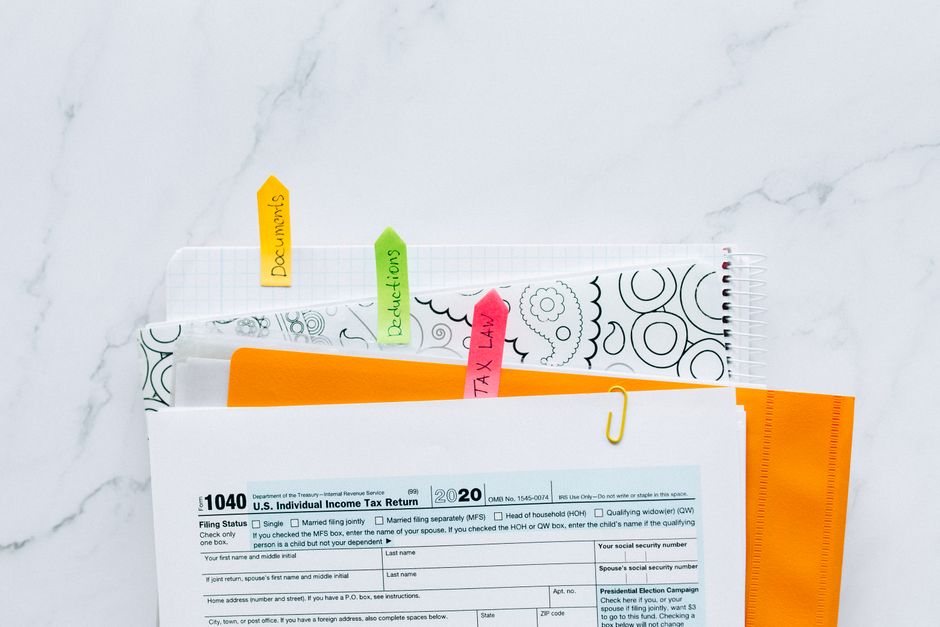
Form 1040 is the standard form used for individual income tax filing in the United States, and nearly every taxpayer starts here regardless of income complexity.
The 1040 itself is short, but its supporting schedules do the heavy lifting:
- Schedule 1 – additional income and adjustments (side income, student loan interest, HSA contributions)
- Schedule 2 – additional taxes (self-employment tax, alternative minimum tax)
- Schedule 3 – additional credits and payments (education credits, foreign tax credit)
- Schedule C – profit or loss from a business (sole proprietors and single-member LLCs)
- Schedule SE – self-employment tax calculation
When You Need Schedule C
Anyone earning income as an independent contractor, freelancer, or sole proprietor reports that income on Schedule C, not as generic "other income." This is where you also deduct legitimate business expenses—software subscriptions, mileage, supplies—that directly reduce your taxable income.
Example: A freelance graphic designer earning $45,000 in 1099-NEC income for the year reports gross revenue and business expenses on Schedule C. After deducting $6,000 in legitimate business expenses (software, a portion of home internet, mileage to client meetings), her net profit is $39,000. That net profit flows to Schedule SE, where she calculates self-employment tax at 15.3%—covering both the employer and employee portions of Social Security and Medicare. She then uses that calculation to estimate her quarterly payments for the following year.
Mapping Your Income Documents to Form 1040
- W-2 income flows directly to Form 1040, line 1
- 1099-NEC (nonemployee compensation) supports Schedule C
- 1099-K (payment app and marketplace transactions) also supports Schedule C or Schedule 1, depending on whether the income was business-related
- 1099-MISC covers rents, royalties, and other miscellaneous income types
Mismatched or missing 1099s are one of the most common triggers for IRS notices, so reconcile every form against your own records before filing.
Choosing Tax Software for Tax Preparers vs. DIY Filing
Not all tax software is built for the same user, and conflating consumer-grade tools with professional platforms is a mistake that costs preparers time and clients money.
Consumer software like TurboTax and H&R Block is designed for single-return simplicity: guided interviews, one taxpayer profile, straightforward pricing tiers. It works well for W-2 employees and simple Schedule C filers with a handful of deductions.
Professional-grade platforms—Drake Tax, Lacerte, UltraTax CS—are built for volume and complexity. They include multi-client dashboards, e-file batching so preparers can transmit dozens of returns simultaneously, built-in audit trail documentation, and integrations with practice management and bookkeeping software.
When DIY Software Stops Being Enough
Example: A two-person bookkeeping firm currently uses TurboTax Business to handle a small handful of client returns each season. As their client list grows past 15–20 returns, they start hitting friction: no centralized client data, no batch e-filing, and manual re-entry for every return. They compare Drake Tax (lower upfront cost, steeper learning curve, strong value for high-volume solo and small-firm preparers) against Lacerte (higher cost, deeper integration with QuickBooks, better suited for complex multi-entity returns). For their client mix—mostly Schedule C freelancers and single-member LLCs—Drake's per-return pricing model wins on cost-efficiency.
The Freelancer Tipping Point
Solopreneurs and freelancers should reassess their tools once they cross into multi-state income, add employees or contractors, or start juggling business entities. At that point, the hourly cost of DIY troubleshooting often exceeds what a CPA-grade solution—or simply hiring a CPA—would cost.
Small Business Tax Cheat Sheet: Deadlines, Deductions, and Forms
Keep this reference handy through the year rather than scrambling every April.
Quarterly Estimated Tax Deadlines (2026)
- Q1: April 15, 2026
- Q2: June 15, 2026
- Q3: September 15, 2026
- Q4: January 15, 2027
Calculate estimated payments using 90% of current-year expected tax liability or 100–110% of last year's liability (whichever is safer for your situation) to avoid underpayment penalties.
Top Deductions to Track Year-Round
- Home office deduction – simplified method ($5/sq ft up to 300 sq ft) or actual expense method
- Mileage – standard mileage rate or actual vehicle expenses, never both
- Business meals – generally 50% deductible when directly related to business
- Section 179 depreciation – immediate expensing of qualifying equipment and software purchases instead of multi-year depreciation
LLC vs. S-Corp Election
Example: An e-commerce LLC owner nets $110,000 in annual profit. As a default sole proprietor/LLC, all $110,000 is subject to self-employment tax. Electing S-corp status lets her pay herself a reasonable salary (say, $60,000, subject to payroll tax) while taking the remaining $50,000 as a distribution not subject to self-employment tax—potentially saving several thousand dollars annually. The tradeoff: added payroll compliance, a separate business return, and higher accounting costs, which only make sense once profit consistently clears roughly $40,000–$50,000.
Payroll and Contractor Classification
Misclassifying employees as 1099 contractors is one of the costliest small business mistakes. If you control how, when, and where the work is done, that person is likely a W-2 employee, not a contractor—regardless of how the relationship is labeled.
What Are Tax Preparation Fees in 2025 (and What to Expect in 2026)?
Tax preparation fees vary significantly by return complexity, and understanding the pricing landscape helps you avoid overpaying—or underpaying for expertise you actually need.
Average Fees by Return Type
- Simple Form 1040 (W-2 only): $220–$350
- 1040 with Schedule C: $350–$650
- Multi-entity returns (LLC + personal, S-corp): $800–$2,000+
Flat-Fee vs. Hourly Billing
Example: A first-time small business owner gets two quotes: a $350 flat-fee CPA for a straightforward Schedule C return, and a $600 hourly-billed preparer with an estimated 4–6 hours at $125/hour. The flat fee offers pricing certainty; the hourly quote carries risk if the return turns out more complex than expected. For predictable situations, flat fees win. For genuinely complex, multi-source income, hourly billing with a detailed scope estimate can actually be fairer.
Red Flags to Avoid
- Preparers who guarantee a specific refund amount before reviewing your documents
- Fee structures based on a percentage of your refund
- Anyone unwilling to sign the return as paid preparer (a legal requirement)
When Paying More Is the Smarter Move
A $600 CPA who identifies an S-corp election opportunity, catches a missed Section 179 deduction, or properly documents home office expenses can easily save you multiples of their fee—while a $150 preparer working from a generic checklist may miss those opportunities entirely. For anyone with self-employment income, multiple income streams, or business ownership, the fee comparison should always weigh total tax outcome, not just the invoice.